
By Derrick Henderson, President of Lifestyle Design Homes and a Florida Certified Building Contractor with more than 20 years in construction. Updated October 2026.
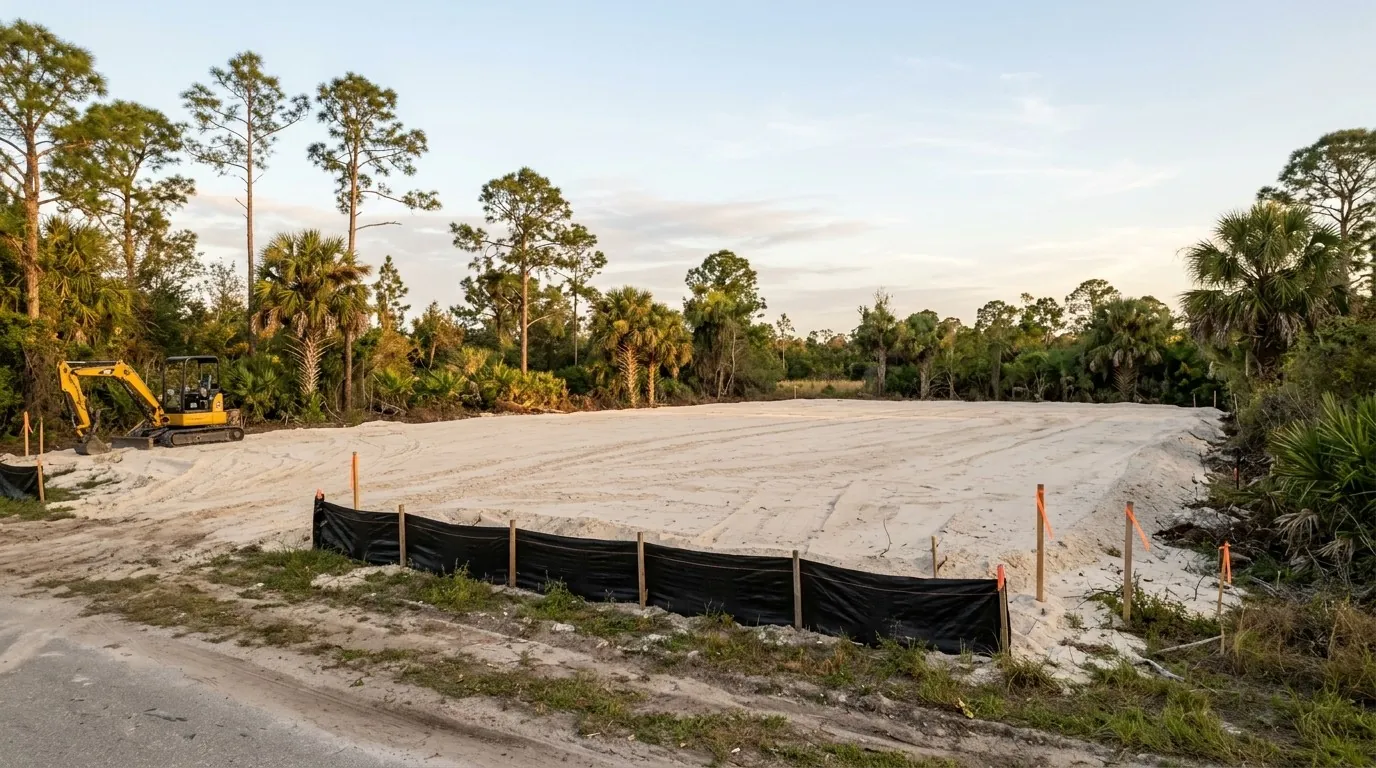
Site preparation in Southwest Florida is the work that turns a lot into a buildable homesite: clearing, fill to the required elevation, a drainage plan, and either utility connections or a well and septic system. It happens before the foundation, and on many lots it moves the budget more than the finishes do. When we asked our team what surprises buyers from other states most, the answer was the cost of preparing the land.
This guide walks through each step, what Collier County and Lee County require, and why two lots at the same price can cost very different amounts to build on. If you have not bought the lot yet, start with our guide to building on your own lot, which covers the fourteen checks to make before you close.
In this guide
- The six steps
- Why two lots at the same price cost differently
- Clearing permits in Collier and Lee
- Wetlands and gopher tortoises
- Fill, grading, and drainage
- Well and septic since 2023
- What it does to the schedule
- How we handle site preparation
- Frequently asked questions
What does site preparation include?
Six steps, roughly in this order. Some run at the same time, and on a lot that already has utilities, elevation, and drainage in place, several of them are small.
| Step | What happens | The rule to know |
|---|---|---|
| 1. Site plan and elevations | A plan drawn on the survey places the home and sets the finished floor height against the road and the flood zone. | In Collier County the site plan shows the crown of the road, the flood zone, the base flood elevation, and the proposed finished floor. |
| 2. Clearing | Trees and vegetation come out of the building area, the driveway, and the septic area. | Collier: the building permit covers up to one acre. Unincorporated Lee: a separate permit only over 5 acres. |
| 3. Protected species and wetlands | The lot is checked for gopher tortoise burrows and wetland areas before equipment arrives. | A state relocation permit within 25 feet of a burrow. Wetlands need state and federal permits first. |
| 4. Fill and grading | Fill brings the building pad to the required height, then the lot is graded so water runs away from the house. | Lowest floor at least one foot above the base flood elevation. Lee: a fill plan above 18 inches over the road crown. |
| 5. Drainage | Roof, driveway, and yard water get a planned path that does not end on a neighbor’s lot. | Collier requires a stormwater plan on lots with one- and two-family homes, with a few exceptions. |
| 6. Utilities, or well and septic | The lot connects to public water and sewer, or gets its own well and septic system. | Nitrogen-reducing septic on lots of one acre or less in BMAP areas since July 1, 2023. |
Why can two lots at the same price cost so differently to build on?
Because the price of a lot reflects where it is and how big it is, not the work it needs. A $30,000 lot can need more site work than a $300,000 one that already has utilities, elevation, drainage, and access in place. These are the three situations we see most.
Large lots, often an acre or more, in Collier County’s Estates zoning. Many have no public water or sewer, so clearing, fill, a well, and a septic system are planned with the house. See our Naples page for the Estates setbacks.
Individual lots with no architectural review, which keeps the choice of plan open. What decides the cost is drainage, fill, setbacks, and, where public lines do not reach the lot, a well and septic system. A low lot price does not mean the lot is ready.
Infill and coastal lots often have water and sewer at the street. The work here is usually elevation: in a mapped flood zone the floor sits at least one foot above the base flood elevation, and the fill and grading follow from that number.
Site work is one of the six lines in our guide to planning a custom home budget, next to the land, impact fees, and the construction itself.
Do you need a permit to clear a lot?
It depends on the county and the size of the clearing. In Collier County, the county rules for vegetation removal say the building permit for a single-family home acts as the clearing permit for up to one acre. Land cleared earlier counts toward that acre, even if a previous owner cleared it: if half an acre is already open, only another half acre can be cleared with the home’s permit. Clearing beyond one acre needs a Vegetation Removal Permit, which staff review within 20 working days of a complete application, with no guaranteed date for issuing it. Some overlay districts, such as the Rural Fringe Mixed Use District, have different limits.
Collier also requires every invasive exotic plant on its list to be removed from the entire property before the certificate of occupancy is issued. The list has twelve species, including Brazilian pepper, melaleuca, Australian pine, and earleaf acacia, and on a lot that has sat empty, removing them can take real work.
In unincorporated Lee County, which includes Lehigh Acres, the county residential building guide requires a separate vegetation removal permit only for property over 5 acres, over 2 acres on Pine Island, or on a barrier island. A typical Lehigh Acres homesite is far smaller. Cities such as Cape Coral, Fort Myers, Bonita Springs, and Estero have their own codes, so we check the address first. In the Village of Estero, for example, a lot cannot be clearcut until the permit for the home itself has been issued.
What about wetlands and gopher tortoises?
Both can stop clearing before it starts. In Collier County, the county cannot issue a clearing permit for wetland areas until the Florida Department of Environmental Protection and the U.S. Army Corps of Engineers have issued their own permits. An informal wetland determination, from the county or from FDEP, tells you early whether that applies.
Gopher tortoises and their burrows are protected by state law. Before land clearing or other development within 25 feet of a burrow, the landowner needs a relocation permit from the Florida Fish and Wildlife Conservation Commission. A walk of the lot before clearing shows whether that step is needed. It is far easier to plan for at the start than to discover with equipment on site.
How much fill does a lot need, and where does the water go?
There is no single number. The fill depends on the flood zone, the existing ground, and the height of the road. In a mapped flood zone, the Florida Building Code puts the lowest floor at least one foot above the base flood elevation, and the pad is built up to carry the house at that height. What each city and county adds to that rule is in our guide to flood zone rules in Collier and Lee. That is why the site plan in Collier County shows the crown of the road, the flood zone, the base flood elevation, and the proposed finished floor side by side: those four numbers decide the fill.
Raising a lot cannot push water onto the neighbors. In unincorporated Lee County, if the final grade will sit more than 18 inches above the crown of the road or a neighboring developed lot, and the lot is not in a subdivision with an active development order, a site fill, grading, and drainage plan has to accompany the permit application. Collier County requires a stormwater plan on lots with one- and two-family homes, with exceptions for some rural agricultural lots and lots already permitted by the South Florida Water Management District.
The wet season, roughly June through September, is when that plan gets tested. Our guide to designing a home for the Southwest Florida climate explains how the floor height and the drainage shape the rest of the design.
Well and septic: what changed in 2023?
Where public water and sewer do not reach the lot, the home needs its own well and septic system, and together they add roughly $20,000 to $40,000 or more. Since July 1, 2023, Florida law requires a new septic system on a lot of one acre or less to be an enhanced nutrient-reducing system instead of a conventional one when the lot sits inside a Basin Management Action Plan area and sewer is not available. These systems cost more and take more design work, so we confirm the requirement for the parcel before the budget is set.
The order of approvals matters too. In unincorporated Lee County, the septic permit has to be issued before the building permit, and both the septic system and the well inspection have to be finaled before the certificate of occupancy. In Collier County, the septic application goes through FDEP, and the septic system has to sit at least five feet from the house.

In Lehigh Acres, the Florida Governmental Utility Authority runs public water and sewer lines in parts of the community and is studying a septic-to-sewer conversion along Lee Boulevard, so two lots a few streets apart can have different answers. We check the address with the utility before we plan the systems. For our clients, we also coordinate the ongoing maintenance and service of the well and septic system, so it is not left to the owner to manage.
Does site preparation delay construction?
It depends on the lot. A homesite with utilities, good elevation, and clean drainage adds little time. A lot that needs fill, a well and septic system, or wetland permits adds several weeks before construction starts, because those approvals come first. Our guide to how long it takes to build a custom home in Florida shows how this fits into the full 9 to 12 months.
How do we handle site preparation?
We look at the land before we price the house. That means the survey, the flood zone and required elevation, the height of the road, drainage, utilities, access for equipment, and any protected species or wetland areas. The site work then sits in the budget as its own line, so the construction price is never mistaken for the whole number.
From there we coordinate the approvals in the right order and plan the well, the septic area, the driveway, the pool, and the drainage together with the house, inside the setbacks. When the land would cost more to prepare than the project can carry, we say so before you commit.
Frequently asked questions
What is site preparation for a new home?
Site preparation is the work that turns a lot into a buildable homesite before the foundation goes in: a site plan with the finished floor height, clearing, fill to the required elevation, grading and drainage, and either utility connections or a well and septic system. In Southwest Florida it often moves the budget more than the finishes do.
Do I need a permit to clear my lot in Collier County?
For a single-family home, the building permit acts as the clearing permit for up to one acre, and land cleared earlier counts toward that acre, even if a previous owner cleared it. Clearing beyond one acre needs a Vegetation Removal Permit, which county staff review within 20 working days of a complete application. Some overlay districts have different limits, and wetlands cannot be cleared without permits from FDEP and the U.S. Army Corps of Engineers.
Do I need a permit to clear a lot in Lehigh Acres?
Usually not a separate one. In unincorporated Lee County, which includes Lehigh Acres, a separate vegetation removal permit is required for property over 5 acres, over 2 acres on Pine Island, or on a barrier island. A typical Lehigh Acres homesite is far smaller than that. Protected species rules still apply, including the state permit for gopher tortoises.
How much fill does a lot in Southwest Florida need?
There is no single number. The fill depends on the flood zone, the existing ground, and the height of the road. In a mapped flood zone, the Florida Building Code puts the lowest floor at least one foot above the base flood elevation. In unincorporated Lee County, if the final grade will sit more than 18 inches above the crown of the road or a neighboring developed lot, a site fill, grading, and drainage plan has to accompany the permit application.
Do I need a nitrogen-reducing septic system?
If the lot is one acre or less, sits inside a Basin Management Action Plan area, and has no sewer available, yes. Since July 1, 2023, Florida law requires a new septic system on those lots to be an enhanced nutrient-reducing system instead of a conventional one. These systems cost more and take more design work, so we confirm the requirement for the parcel before the budget is set.
What if there are gopher tortoises on my lot?
Gopher tortoises and their burrows are protected by state law. Before land clearing or other development within 25 feet of a burrow, the landowner needs a relocation permit from the Florida Fish and Wildlife Conservation Commission. A survey of the lot before clearing shows whether that step is needed, and it is far easier to plan for at the start than to discover with equipment on site.
Does site preparation delay construction?
It depends on the lot. A homesite with utilities, good elevation, and clean drainage adds little time. A lot that needs fill, a well and septic system, or wetland permits adds several weeks before construction starts. In unincorporated Lee County, for example, the septic permit has to be issued before the building permit. Our guide to how long it takes to build a custom home in Florida shows the full schedule.
Before you start
Get the survey and the flood zone, and find the height of the road. Ask whether water and sewer reach the lot, and whether the parcel sits in a BMAP area. Walk the lot for gopher tortoise burrows and standing water. Then price the site work as its own line, before you compare the construction price. When you compare builders, check that each quote prices the site work the same way. Our guide on how to compare custom home builders covers the rest.
Have a lot, or one in mind? Contact Lifestyle Design Homes in Estero. We will tell you what it needs before you commit.
Start a conversation