By Derrick Henderson, President of Lifestyle Design Homes and a Florida Certified Building Contractor with more than 20 years in construction across Southwest Florida. Updated September 2026.
Choosing a custom home builder in Naples is the decision that shapes every other decision in your project. The land you buy, the plan you build, the budget you set, and the experience you have for the next year all run through this one choice. This guide covers what to check, what to ask, and what to compare before you sign.
In this guide
- What a custom home builder does
- Custom home builder vs general contractor
- How to verify a builder’s license in Florida
- Questions to ask before you sign
- How to compare custom home builders
- The red flag I watch for
- What an early site evaluation catches
- How pricing and contracts work
- How long a custom home takes to build
- What happens after you sign
- Building in Naples and Southwest Florida
- When a custom home is not the right choice
- Frequently asked questions
What does a custom home builder do?
A custom home builder leads the full journey of creating a home that does not exist yet: evaluating land, directing architectural design, coordinating engineering, securing permits, managing construction, and delivering the finished home. One team stays accountable from the first conversation to the final walkthrough.
That scope matters. When land evaluation, design, and construction live in separate companies, information gets lost at every handoff. When they live in one team, every decision is made with the full picture in view.
What is the difference between a custom home builder and a general contractor?
A general contractor manages construction from plans that already exist. A custom home builder leads the entire process, including the parts that happen before construction: whether the lot suits the plan, whether the design fits the budget, and whether the details will survive contact with Florida permitting.
Neither is better in the abstract. If you already have finished architectural plans and a permitted lot, a general contractor may be all you need. If you are starting from land and a vision, you want the team that owns the whole journey. If timing matters more than starting from a blank page, a builder’s own available homes are a third path.
How do you verify a builder’s license in Florida?
Ask the builder for the license number, then search it on MyFloridaLicense.com, the state’s official portal. Check that the license is current, that it matches the company you are talking to, and that it carries no discipline history.
Florida licenses contractors by scope, and the classes matter:
Can build structures of any type and size.
Can build commercial and residential buildings up to three stories, which covers virtually every custom home in Southwest Florida.
Limited to one, two, and three family residences of up to two habitable stories.
Every legitimate builder will give you their license number without hesitation. Ours is CBC1268790, held by Derrick Henderson. Ask for proof of general liability insurance and workers’ compensation at the same time. A builder who hesitates on any of this is a builder to cross off the list.
Questions to ask a custom home builder before you sign
The early conversations tell you more than the portfolio. Ask these, and pay attention to how the answers are given, not just what they are:
- What is not included in the price you are showing me?
- Who evaluates the land before design begins, and what does that review cover?
- Are design, estimating, and construction handled by one team or subcontracted apart?
- What license do you hold, and what is the number?
- How do you price the project: fixed price, cost plus, or allowances?
- How are changes priced and communicated once construction starts?
- Who is my single point of contact, and how often will I hear from them?
- Can I speak with a client whose home you delivered more than a year ago?
The first one on that list is the one buyers almost never ask.
“Buyers spend a lot of time comparing base prices, but two homes with the same advertised price can have very different final costs. Understanding allowances, site costs, finishes, impact fees, and what is considered an upgrade is just as important as knowing the starting price.”
Derrick Henderson, President
How to compare custom home builders
Two proposals rarely describe the same house, so compare what is behind each number before you compare the numbers. These are the seven things we would line up side by side.
| What to compare | What to ask for |
|---|---|
| Price | The exclusions in writing, item by item. |
| Allowances | The dollar amount behind each allowance and the quality level it buys. |
| The lot | Who evaluates the homesite, and whether that happens before design or after. |
| Timeline | Two numbers: the months before the permit and the months of construction after it. |
| Changes | A written change order with the cost and schedule impact, approved by you before the work proceeds. |
| Communication | One point of contact, one platform, and how often you will receive updates. |
| License | The license number, verified by you on the state portal. |
How do you know a builder will stay on budget and on schedule?
You cannot know for certain, but you can check how the builder controls both. On budget, look for a price built on a defined scope, clear allowances, and a contingency. We typically recommend planning for a contingency of about 5%, and on a well-defined project it may never be used. On schedule, look for a builder who asks for selections early and documents every change before work proceeds. Late decisions and changes made after a deadline are among the most common causes of delay.
The red flag I watch for
“Watch out when a builder is willing to give you a firm price before they truly understand your lot, plans, and selections. A number can look great at the beginning, but if it isn’t based on enough information, you’re probably going to find out what was missing later. I’d rather have an uncomfortable pricing conversation upfront than surprise a client with costs halfway through their project.”
Derrick Henderson, President
Beyond that one signal, watch the pattern: vague answers about what is included, pressure to sign before the site has been evaluated, and pricing that sounds meaningfully lower than every other bid without a clear explanation of why.
What an early site evaluation catches
Buyers often find a lot where the asking price looks like an opportunity. The purchase price and the cost to build on it are two different numbers, and the gap between them is where projects go wrong.
“We have had clients bring us properties they were considering purchasing because the price of the land looked like a great deal. Once we evaluated the property from a construction standpoint, there were site conditions that could have created significant additional costs to make the lot buildable. Instead of looking only at the purchase price, we were able to show the client what the true cost of building on that property could look like before they committed to it. That conversation potentially saved them tens of thousands of dollars and, more importantly, kept them from buying a lot that didn’t make sense for what they wanted to build.”
Derrick Henderson, President
If you are looking at land now, our guide to building on your own lot covers what a site review should include.
How pricing and contracts usually work
A serious custom home budget covers the complete project, not only the construction estimate: site preparation, design and engineering, permitting, utilities, landscaping, pools, and a contingency for what the site reveals along the way. We wrote a separate guide to planning a realistic custom home budget, and our guide to construction loans in Florida covers how financing fits in.
Ask which items sit outside the construction price. Pools and spas, extensive landscaping, furnishings, generators, elevators, specialty site work, and utility extensions are commonly priced separately, and any of them can change the total investment. The contract, specifications, allowances, and approved selections define exactly what is included.
The structure of the contract matters as much as the number. Understand what the allowances buy, how overages are handled, and what happens to the schedule when selections change. A builder who explains this clearly before signing will communicate clearly after.
Can you negotiate with a custom home builder?
Yes, but the productive negotiation is rarely about the headline price. A reputable builder’s margin reflects the team, warranty, and accountability you are buying. Where you have real room is scope: adjusting the plan, phasing certain features, revisiting allowances, and choosing where the budget works hardest. A builder who instantly drops the price without changing the scope is telling you the first number was not real.
How long does it take to build a custom home?
A typical custom home in Southwest Florida takes 9 to 12 months from the first meeting to move-in. Construction is 6 to 8 months of that, counted from the day the permit is issued.
“For most of our homes, we tell clients to expect about six to eight months of construction once the permit is issued. The size and complexity of the home ultimately determine the timeline, and the design and permitting period before construction varies from project to project.”
Derrick Henderson, President
The part worth understanding is what sits in front of those 6 to 8 months. Design development, architectural and engineering work, selections, pricing, and permitting all happen before a shovel moves. Those phases vary depending on how customized the home is, how quickly decisions get made, the condition of the lot, and county permitting timelines.
For a typical custom home, our planning numbers are 2 to 3 weeks for the floor plan, 6 to 8 weeks for engineering and architectural development, and 4 to 6 weeks for permitting in Collier and Lee County. Several of those phases overlap, which is how the total stays at 9 to 12 months.
That is why the answer to “how long will this take” comes in two parts: the months before the permit and the months of construction after it. A builder who quotes one figure without showing what is behind it is either guessing or leaving something out.
We break the full schedule down in our guide to how long it takes to build a custom home in Florida, phase by phase.
What happens after you sign
Signing the contract should not be the point where communication disappears. It is worth asking any builder exactly what the next 12 months look like from your side.
“Our clients have a defined team around their project, and as they move from design into construction, they know who their primary point of contact is and where to go for project information. During construction we use Buildertrend as the central communication and project management platform, so clients have visibility into their project rather than relying on scattered texts and emails. A client shouldn’t have to constantly chase their builder to understand what’s happening with their home.”
Derrick Henderson, President
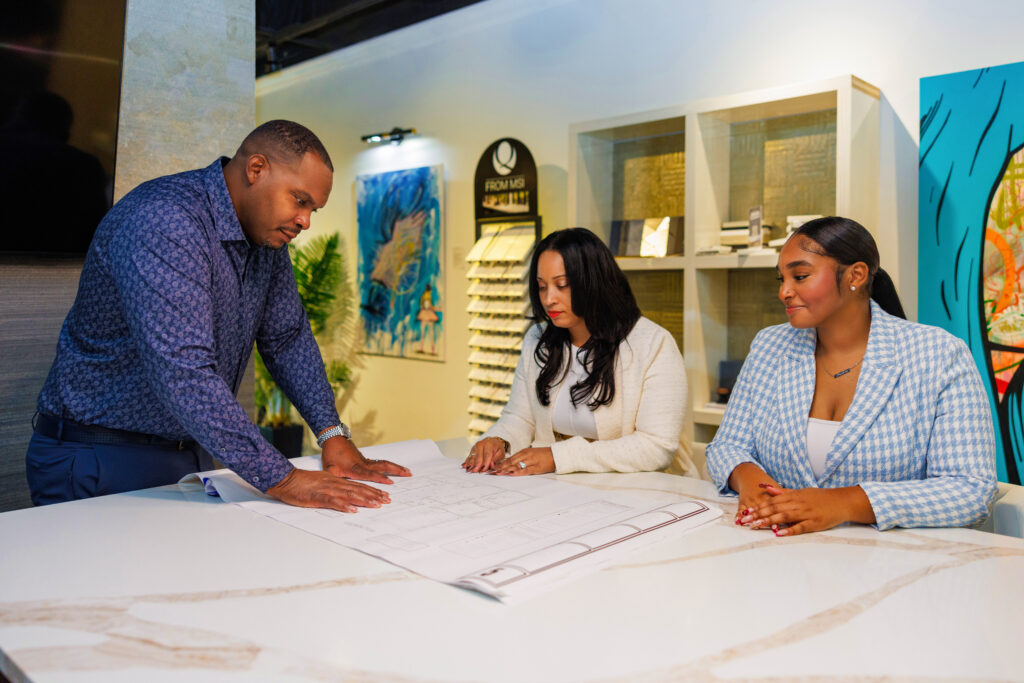
With us, the contact changes as the project moves forward, and the client is told who it is at each stage. A New Home Sales Consultant sets the direction at the start. The Design Team handles architecture, finishes, and selections. Operations handles documentation, permitting, and project setup. Once construction begins, the Project and Construction Team runs the schedule, the trades, and quality. Clients typically receive project updates every 2 weeks through Buildertrend.
Choosing a builder in Naples and Southwest Florida specifically
Building here is a local discipline, and buyers moving from other states are usually surprised by two things.
The first is how much the lot itself drives the project. Flood zone, required elevation, fill, drainage, utilities or well and septic requirements, and general site conditions can materially change the cost and the design before you get into the house at all.
The second is Florida’s building requirements, particularly around wind resistance and hurricane protection. Buyers moving from other states do not always realize how much local codes and permitting requirements influence the way homes here have to be designed and constructed.
Permitting also runs differently across Collier County and Lee County, and differently again inside gated communities with their own architectural review. A builder who works these processes every week prices and schedules them accurately. One who does not will discover them inside your timeline. See where we build across Southwest Florida for how each community shapes the work, and the NAHB consumer resources for general guidance on working with builders.
When the plan you love does not fit the lot you have
This comes up more often than people expect, and how a builder handles it tells you what kind of partner they will be.
“I love the direction of the home, but I don’t want to force a house onto a lot that isn’t right for it. Let’s figure out what you love most about this plan and see whether we can adapt those elements to your property. If we can’t do that without compromising the home, then I’d rather tell you that now and help you find the right solution.”
Derrick Henderson, President
Our job is not just to say yes. Sometimes protecting a client’s vision means being willing to tell them when something does not work.
When is a custom home not the right choice?
“If your number one priority is getting into a home as quickly as possible, or getting the absolute lowest price per square foot, a fully custom home probably isn’t the right product for you. Custom building makes the most sense for someone who values having a home designed around their lifestyle, property, priorities, and aesthetic, and understands that making those decisions takes more time and involvement. Sometimes I will tell someone that one of our existing homes or established floor plans makes more sense for them, and I’m completely comfortable doing that.”
Derrick Henderson, President
For many families the better starting point is a considered plan rather than a blank page. Our custom home floor plans across the Gold, Noir, and Luxe collections exist for exactly that path: strong bones, adapted to your lot and the way you live.
Frequently asked questions
How is a custom home priced?
Custom homes are usually priced one of three ways: a fixed price for a defined scope, cost plus a builder fee, or a base price with allowances for selections you have not made yet. All three are legitimate. What matters is knowing which one you are looking at, and what sits outside it. Ask for the exclusions in writing before you compare two builders. Our guide to planning a custom home budget covers the categories that often sit outside a construction estimate.
Why do two builders quote such different prices for the same house?
Almost always because they are not quoting the same house. Different allowance levels, different site work assumptions, different exclusions. Before comparing two numbers, line up what each one includes: site preparation, impact fees, utilities, landscaping, pool, and the quality level behind every allowance. A lower number with thinner allowances usually means the cost shows up later.
How long does it take to build a custom home in Southwest Florida?
A typical custom home takes 9 to 12 months from the first meeting to move-in. Construction is about 6 to 8 months of that, counted from the day the permit is issued. Larger or more highly customized homes take longer.
Is it cheaper to build or to buy in Southwest Florida?
Buying an existing home is usually faster, and often cheaper per square foot. Building gets you a home shaped around your lot and the way you live, without paying to renovate someone else’s decisions. The answer depends on how much you would need to change about the homes currently for sale. If the answer is very little, buy. If the answer is a great deal, building starts to make sense.
What should a custom home contract include?
At minimum: the scope in plain language, the price structure and what sits outside it, the allowance schedule, how change orders are priced and approved, a payment schedule tied to milestones, the construction timeline, and the warranty. If any of those are missing or vague, that is the conversation to have before signing, not after.
Should I buy land before choosing a custom home builder?
Ideally, no. Bring the builder in before you close on the lot, or at least before design begins. A builder who knows the area can tell you what a specific lot will cost to build on: fill, elevation, access, utilities, and drainage. See building on your own lot for what a site review should cover.
Do custom home builders work with plans I already have?
Most will, but ask how. Plans drawn without a builder at the table often need real revision for cost, constructability, and Florida code. Another path is starting from a proven plan and personalizing it, which is how our floor plan collections are meant to be used.
Can I bring my own architect?
Some builders work only from their own design team, some collaborate with outside architects, and some do both. Ask early, because the answer changes how the project is priced and who is accountable when a design detail meets a construction reality. If a builder handles design in house, ask how much input you have in that process and who you talk to about it.
What license should I check for a custom home builder in Florida?
A Certified Building Contractor license covers residential buildings up to three stories, which includes virtually every custom home in Southwest Florida. A Certified General Contractor license covers any size structure. Ask for the number, then verify it yourself on the state portal and confirm it is current and matches the company name on your contract.
How far in advance should I start talking to builders?
Earlier than feels necessary. The best time is while you are still deciding between lots, or between building and buying, because those decisions change based on what a builder can tell you. The first conversation costs nothing and usually prevents the most expensive mistakes.
What should I bring to a first meeting with a builder?
Whatever you have: a lot address, a plan you like, photos of homes that feel right, and a realistic budget range. You do not need finished answers. A good first meeting is the builder asking you questions, not the other way around.
The decision, in one paragraph
Verify the license. Ask what is not included in the price. Insist on one accountable team. Listen for clarity rather than perfection, and talk to a past client who has lived in the home for more than a year. Then choose the people you want beside you for a year of decisions.
Ready to have that first conversation? Contact Lifestyle Design Homes in Estero. We will tell you honestly whether we are the right fit.
Start a conversation